
Artificial intelligence, machine learning, and deep learning are some of the most commonly used terms in technology today.
They are also some of the most misunderstood.
Many people use these terms interchangeably, but they do not mean the same thing. The simplest way to understand the relationship is this:
- Artificial intelligence (AI) is the broad idea of machines performing tasks that appear intelligent.
- Machine learning (ML) is one way to build AI systems by learning patterns from data.
- Deep learning (DL) is a specialized type of machine learning that uses layered neural networks.
So the relationship looks like this:
Deep Learning ⊂ Machine Learning ⊂ Artificial Intelligence
That means deep learning is part of machine learning, and machine learning is part of AI.
In this article, we’ll break that down in plain language and show where each concept fits—with practical examples.
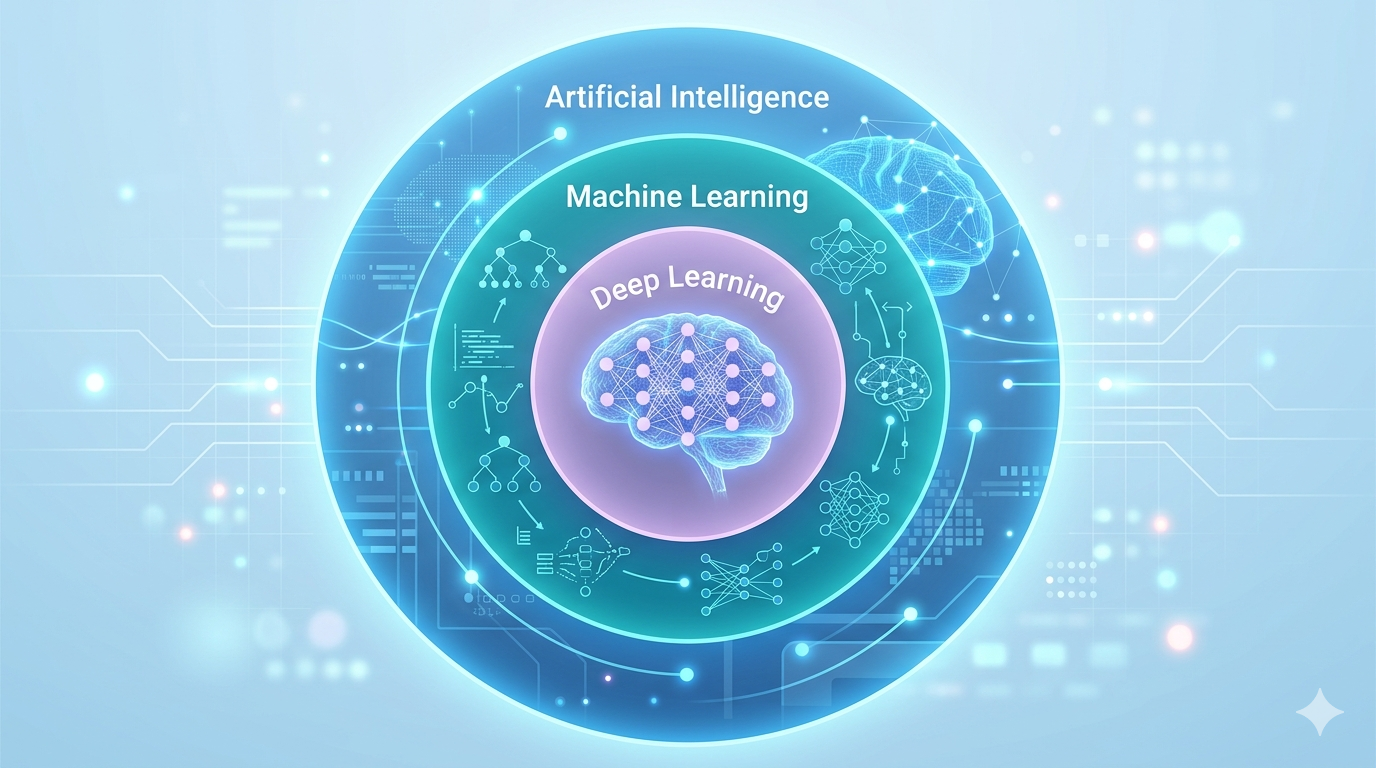
Artificial Intelligence: The Big Umbrella
Artificial intelligence is the broadest term.
It refers to computer systems designed to perform tasks that normally require human intelligence, such as:
- recognizing images
- understanding language
- making predictions
- recommending products
- detecting fraud
- generating text, code, or images
AI is not a single technology. It is a field that includes many different approaches.
Some AI systems use fixed rules written by humans. Others learn from data. Many modern systems combine multiple methods.
Simple way to think about AI
AI is the goal: making machines do useful things that seem intelligent.
Examples of AI
- a chatbot answering questions
- spam filters sorting emails
- Google Maps predicting traffic
- Netflix recommending shows
- software that detects faces in photos
Machine Learning: A Way to Achieve AI
Machine learning is a subset of artificial intelligence.
Instead of programming every rule manually, machine learning trains a model using data so it can learn patterns and make predictions.
For example, rather than writing hundreds of rules to detect spam email, you can train a machine learning model on examples of spam and non‑spam emails. The model learns the patterns on its own and applies them to new messages.
Simple way to think about machine learning
Machine learning is how many AI systems learn from data instead of relying only on hard‑coded instructions.
Machine learning is especially useful when:
- the rules are too complex to write by hand
- the data changes over time
- predictions improve as more examples are added
Examples of machine learning
- predicting house prices
- detecting credit card fraud
- recommending products
- forecasting demand
- classifying customer support tickets
Deep Learning: A More Advanced Form of Machine Learning
Deep learning is a subset of machine learning.
It uses neural networks with many layers to learn patterns from very large amounts of data. These layered models are especially effective for tasks involving images, audio, video, and natural language.
Deep learning has enabled major breakthroughs in areas such as:
- speech recognition
- image classification
- machine translation
- large language models
- generative AI tools
Simple way to think about deep learning
Deep learning is a specialized machine learning approach that excels at complex pattern recognition.
Examples of deep learning
- image recognition in medical scans
- voice assistants understanding speech
- text generation in chatbots
- perception systems for self‑driving vehicles
- AI image generation tools
The Easiest Analogy
Here’s a simple analogy:
- Artificial Intelligence is the entire transportation industry.
- Machine Learning is one type of vehicle, like a car.
- Deep Learning is a high‑performance electric car built for advanced tasks.
Or even simpler:
- AI = the big field
- ML = a method inside AI
- DL = a method inside ML
Quick Comparison Table
| Term | What it means | Scope | How it works | Example |
|---|---|---|---|---|
| Artificial Intelligence | Making machines perform intelligent tasks | Broadest | Rules, logic, learning, or hybrids | Chatbots, recommendations, fraud detection |
| Machine Learning | AI that learns patterns from data | Narrower | Trains models on examples | Spam filters, demand forecasting |
| Deep Learning | ML using multi‑layer neural networks | Most specialized | Learns complex patterns from large datasets | Image recognition, speech AI, generative AI |
AI Does Not Always Mean Machine Learning
This is one of the biggest misunderstandings.
Not every AI system uses machine learning.
Some systems are entirely rule‑based, such as:
- a decision engine that follows business rules
- a tax calculator
- a workflow automation tool with fixed logic
These systems may still be called AI if they automate intelligent‑seeming decisions, but they do not learn from data.
Machine learning becomes important when a system needs to improve based on examples rather than follow only explicit instructions.
Machine Learning Does Not Always Mean Deep Learning
This is another common source of confusion.
A machine learning model does not have to be a neural network.
Many effective machine learning systems use methods such as:
- linear regression
- decision trees
- random forests
- gradient boosting
- clustering algorithms
Deep learning is powerful, but it is not always the best choice.
In many business applications, traditional machine learning is easier to train, faster to deploy, cheaper to run, and easier to explain.
Where Generative AI Fits
Generative AI is what many people encounter today through tools like ChatGPT, image generators, and coding assistants.
Most modern generative AI systems are built using deep learning, especially large neural network architectures such as transformers.
So where does generative AI fit?
Generative AI → Deep Learning → Machine Learning → Artificial Intelligence
This is why these terms often appear together in discussions and marketing.
Practical Business Examples
Example 1: Customer support chatbot
- AI: the overall chatbot experience
- Machine learning: classifying user intent
- Deep learning: advanced language understanding and response generation
Example 2: Fraud detection system
- AI: the full fraud prevention solution
- Machine learning: identifying suspicious transaction patterns
- Deep learning: modeling complex behavior at large scale
Example 3: Medical image analysis
- AI: the diagnostic assistance system
- Machine learning: structured risk scoring
- Deep learning: analyzing scans and detecting visual patterns
Which Term Should You Use?
Use the most accurate term for the situation:
- Say AI when speaking broadly about intelligent systems
- Say machine learning when the system learns from data
- Say deep learning when referring to neural‑network‑based models
Using precise language builds trust and helps others understand what a system actually does.
Why the Difference Matters
Understanding the difference between AI, machine learning, and deep learning helps you:
- communicate more clearly
- evaluate tools more accurately
- avoid hype and confusion
- choose better solutions for real problems
Not every problem needs deep learning. Not every automation tool uses machine learning. And not everything labeled “AI” works the way people assume.
Final Takeaway
Here is the simplest possible summary:
- Artificial intelligence is the broad field
- Machine learning is a subset of AI that learns from data
- Deep learning is a subset of machine learning that uses layered neural networks
If you remember one line, remember this:
AI is the big umbrella, machine learning is one approach under it, and deep learning is a specialized branch of machine learning.
That mental model will make modern AI discussions much easier to understand.
FAQ
Is machine learning the same as artificial intelligence?
No. Machine learning is one part of artificial intelligence. AI is the broader field.
Is deep learning better than machine learning?
Not always. Deep learning excels at complex tasks like language and vision, but traditional ML is often simpler, cheaper, and easier to explain.
Does all AI use deep learning?
No. Many AI systems use rules, logic, search methods, or traditional machine learning.
Is ChatGPT AI, machine learning, or deep learning?
It is all three. ChatGPT is an AI system built using deep learning, which is a subset of machine learning.
Why do people confuse AI, ML, and DL?
Because they are closely related and often used together in products, articles, and marketing—but they describe different layers of the same technology stack.