
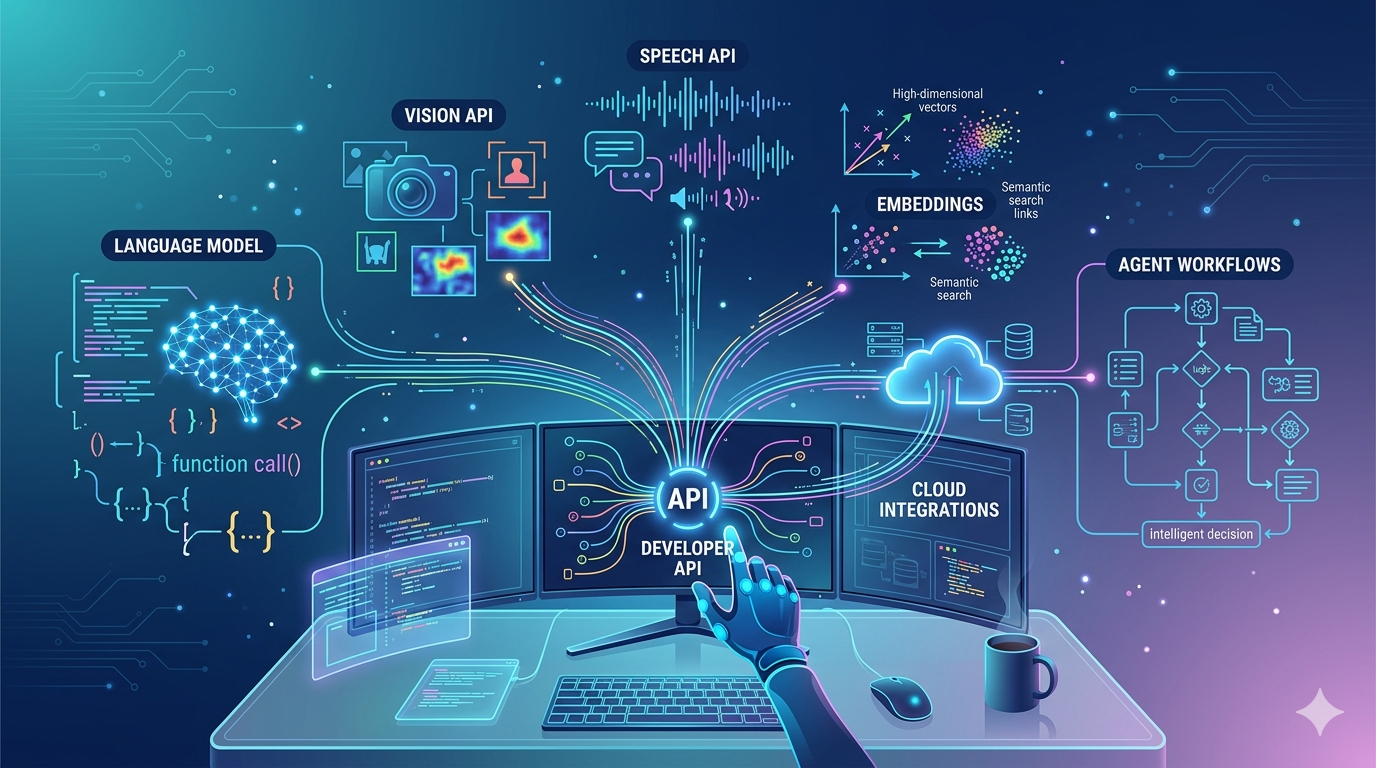
Quick recommendation: For most developers, start with OpenAI, Azure OpenAI, Anthropic Claude, or Google Gemini. For enterprise and multi-model flexibility, also explore AWS Bedrock, Mistral AI, and Cohere.
Who Should Read This?
- Software developers building AI-powered applications
- .NET, JavaScript, Python, and cloud developers exploring AI APIs
- Architects comparing AI providers for enterprise projects
- Developers preparing for AI, cloud, or solution architecture interviews
- Teams planning RAG, chatbot, document AI, or AI agent solutions
Key Takeaways
- OpenAI is a strong general-purpose choice for text, reasoning, coding, vision, and app development.
- Azure OpenAI is useful for enterprise teams already using Microsoft Azure and Azure security services.
- Anthropic Claude is strong for long-context reasoning, writing, analysis, and agent-style workflows.
- Google Gemini is useful for multimodal AI, Google ecosystem integration, and developer experimentation.
- AWS Bedrock is useful when teams want access to multiple foundation models through AWS.
- Mistral AI is a strong option for developers who want performant models, open-weight options, and European AI provider choices.
- Cohere is especially useful for embeddings, reranking, search, and retrieval-augmented generation.
Table of Contents
- What Is an AI API?
- How to Choose the Right AI API
- 1. OpenAI API
- 2. Azure OpenAI Service
- 3. Anthropic Claude API
- 4. Google Gemini API
- 5. Amazon Bedrock
- 6. Mistral AI API
- 7. Cohere API
- AI API Comparison Table
- Which AI API Should Developers Choose?
- FAQ
What Is an AI API?
An AI API allows developers to add artificial intelligence capabilities to applications without training large AI models from scratch. Instead of building a model yourself, you send a request to an API and receive an AI-generated response. AI APIs can help with:- Text generation
- Code generation
- Chatbots
- Document summarization
- Image understanding
- Speech-to-text and text-to-speech
- Embeddings and semantic search
- RAG applications
- AI agents and workflow automation
How to Choose the Right AI API
The best AI API depends on the type of application you are building. Before choosing a provider, developers should consider practical factors like model quality, cost, latency, security, SDK support, cloud integration, and data privacy. Important questions to ask:- Do you need text, image, audio, or multimodal support?
- Do you need strong reasoning or fast low-cost responses?
- Are you building a chatbot, RAG system, AI agent, or coding assistant?
- Do you need enterprise security and compliance?
- Will your application run on Azure, AWS, Google Cloud, or multiple clouds?
- Do you need embeddings, reranking, or vector search?
- How important are cost, latency, and rate limits?
1. OpenAI API
The OpenAI API is one of the most popular AI APIs for developers. It is commonly used for chatbots, coding assistants, content generation, summarization, reasoning, multimodal applications, and AI-powered productivity tools. OpenAI is a strong choice when you want a mature developer platform with strong model capability, SDK support, and a large ecosystem. Developers can use OpenAI models for text, vision, coding, structured outputs, function calling, embeddings, and realtime experiences.Best for
- General-purpose AI applications
- Chatbots and assistants
- Code generation and code review
- Structured output generation
- AI product prototypes
- Multimodal AI applications
Developer use cases
- AI support assistant
- Resume analyzer
- Code explanation tool
- Document summarizer
- SQL query generator
- AI writing assistant
2. Azure OpenAI Service
Azure OpenAI Service is a strong option for enterprise developers and teams already using Microsoft Azure. It provides access to OpenAI models through Azure, which makes it attractive for organizations that need Azure identity, networking, monitoring, and governance. For .NET and Azure developers, Azure OpenAI is especially useful because it fits naturally with Azure App Service, Azure Functions, Azure AI Search, Azure Key Vault, Application Insights, and enterprise security patterns.Best for
- Enterprise AI applications
- .NET and Azure cloud projects
- Secure internal chatbots
- RAG applications using Azure AI Search
- Applications requiring Azure monitoring and governance
Developer use cases
- Internal knowledge assistant
- HR policy chatbot
- Customer support summarization
- AI search over business documents
- Secure enterprise RAG solution
3. Anthropic Claude API
The Anthropic Claude API is another strong AI API for developers. Claude models are often used for long-form reasoning, writing, summarization, analysis, coding tasks, and applications that need careful instruction following. Claude is a good option when your application needs to work with longer documents, detailed instructions, or complex reasoning workflows. It is also popular for AI agents, code-related tasks, and document-heavy applications.Best for
- Long document analysis
- Reasoning-heavy workflows
- Writing and editing assistants
- Code explanation and refactoring
- AI agent workflows
Developer use cases
- Legal document summarizer
- Technical documentation assistant
- Codebase explanation tool
- Research assistant
- Customer email response generator
4. Google Gemini API
The Google Gemini API is useful for developers building multimodal AI applications. Gemini can support use cases involving text, images, documents, code, and other AI-powered application scenarios. Gemini is a strong choice for developers who are already using Google Cloud, Firebase, Android, Google Workspace, or Google AI Studio. It is also useful for experimentation because Google provides developer-friendly tooling around Gemini API development.Best for
- Multimodal AI applications
- Google ecosystem projects
- AI prototypes and experiments
- Image and text understanding
- Developer learning projects
Developer use cases
- Image-based assistant
- Document understanding app
- Educational AI tutor
- Product description generator
- Multimodal chatbot
5. Amazon Bedrock
Amazon Bedrock is useful for developers and organizations building AI applications on AWS. Instead of using only one model provider, Bedrock gives access to multiple foundation models through AWS services. Bedrock is helpful when teams want model flexibility, AWS-native security, and integration with other AWS services. It is a good fit for companies that already use AWS for application hosting, storage, data, and infrastructure.Best for
- AWS-based AI applications
- Multi-model access
- Enterprise AI architecture on AWS
- Secure generative AI applications
- Teams comparing different foundation models
Developer use cases
- AWS-hosted chatbot
- Document Q&A system
- Enterprise knowledge assistant
- AI workflow automation
- Model comparison platform
6. Mistral AI API
Mistral AI is a strong option for developers who want high-performance models, open-weight options, and flexible deployment choices. Mistral is often considered by teams that care about efficiency, European AI providers, and developer-friendly model access. Mistral can be useful for chat, coding, embeddings, document AI, moderation, and workflow-oriented AI applications. It is worth exploring when you want alternatives to the largest US-based AI providers.Best for
- Developer experimentation
- Open-weight model options
- Cost-conscious AI applications
- European AI provider preference
- Document and coding use cases
Developer use cases
- Code assistant
- Document extraction workflow
- Internal chatbot
- Lightweight AI automation
- RAG application backend
7. Cohere API
Cohere is especially useful for developers building search, embeddings, reranking, and retrieval-augmented generation applications. While many AI providers focus heavily on chat models, Cohere is well known for practical enterprise retrieval workflows. If your project includes semantic search, document ranking, knowledge retrieval, or RAG quality improvement, Cohere is worth considering. Reranking can be especially useful when your application retrieves many documents but needs to show the most relevant results first.Best for
- Embeddings
- Reranking
- Semantic search
- RAG applications
- Enterprise search experiences
Developer use cases
- Knowledge base search
- Document retrieval system
- RAG answer improvement
- Semantic product search
- Customer support article ranking
Best AI APIs for Developers in 2026: Comparison Table
| AI API | Best For | Good Developer Use Cases | Best Fit |
|---|---|---|---|
| OpenAI API | General AI, coding, reasoning, multimodal apps | Chatbots, coding tools, assistants, structured outputs | Most developers |
| Azure OpenAI | Enterprise AI on Azure | Secure RAG, internal assistants, Azure AI apps | .NET and Azure teams |
| Anthropic Claude | Long-context reasoning and document work | Analysis, writing, coding, document summarization | Reasoning-heavy apps |
| Google Gemini | Multimodal AI and Google ecosystem apps | Image understanding, content apps, prototypes | Google Cloud and multimodal projects |
| Amazon Bedrock | AWS-native multi-model AI | Enterprise AI, model comparison, AWS apps | AWS teams |
| Mistral AI | Efficient models and open-weight options | Coding, document AI, internal assistants | Cost-conscious and flexible AI apps |
| Cohere | Embeddings, reranking, semantic search | RAG, knowledge search, document ranking | Search and retrieval apps |
Which AI API Should Developers Choose?
If you are a beginner, start with one general-purpose API first. OpenAI, Claude, Gemini, and Azure OpenAI are good starting points depending on your ecosystem and project goals. If you are a .NET or Azure developer, Azure OpenAI is a very practical choice because it connects well with Azure services. You can build real-world projects using Azure App Service, Azure Functions, Azure AI Search, Blob Storage, Key Vault, and Application Insights. If you are building RAG applications, do not focus only on the chat model. Also compare embeddings, vector search, reranking, chunking strategy, grounding, and evaluation. If you are building enterprise AI applications, consider security, auditability, monitoring, data privacy, rate limits, model lifecycle, and cost controls from the beginning.Recommended Learning Path for Developers
- Start with prompt basics: Learn how to send requests and receive responses.
- Add structured outputs: Return JSON that your application can validate and process.
- Use embeddings: Convert text into vectors for search and similarity matching.
- Build a RAG app: Connect your model to documents or business knowledge.
- Add tools or function calling: Allow AI to call APIs, databases, or backend services safely.
- Add observability: Track latency, errors, cost, token usage, and quality.
- Evaluate responses: Test accuracy, safety, hallucination risk, and business value.
Final Thoughts
The best AI APIs for developers in 2026 are not only about model quality. Developers should also think about integration, security, cost, latency, observability, and long-term maintainability. OpenAI, Azure OpenAI, Anthropic Claude, Google Gemini, AWS Bedrock, Mistral AI, and Cohere are all useful options depending on the project. The right choice depends on whether you are building a chatbot, coding assistant, enterprise RAG system, document AI workflow, search experience, or AI agent. For developers, the best approach is to start small, build a working prototype, measure quality, and then choose the API that fits your architecture and business needs. Continue learning on the Learn page or explore practical tools on the AI Tools page.Official AI API Documentation
Developers should always check the official documentation before choosing an AI API because models, pricing, limits, and SDKs change frequently.- OpenAI API models documentation
- Microsoft Foundry and Azure AI documentation
- Anthropic Claude API documentation
- Google Gemini API documentation
- Amazon Bedrock documentation
- Mistral AI documentation
- Cohere documentation
FAQ: Best AI APIs for Developers in 2026
What is the best AI API for developers in 2026?
There is no single best AI API for every project. OpenAI is a strong general-purpose choice, Azure OpenAI is excellent for Azure enterprise applications, Claude is strong for reasoning and long documents, Gemini is useful for multimodal use cases, Bedrock is useful for AWS teams, Mistral is useful for flexible model options, and Cohere is strong for embeddings and reranking.Which AI API is best for .NET developers?
Azure OpenAI is a strong choice for .NET developers because it integrates well with Azure services, identity, monitoring, and enterprise cloud architecture. OpenAI can also be used directly from .NET applications through REST APIs or SDKs.Which AI API is best for RAG applications?
For RAG applications, Azure OpenAI with Azure AI Search is a strong enterprise option. OpenAI, Claude, Gemini, Bedrock, Mistral, and Cohere can also be used depending on your architecture. For RAG quality, embeddings and reranking are just as important as the chat model.Which AI API is best for embeddings?
OpenAI, Azure OpenAI, Cohere, Mistral, and other providers offer embedding options. Cohere is especially popular for search and reranking workflows.Should developers use one AI API or multiple providers?
For learning and MVP projects, start with one provider. For production systems, some teams use multiple providers for fallback, cost optimization, model comparison, or business continuity.Are AI APIs expensive?
AI API cost depends on model choice, token usage, request volume, response size, and whether you use text, image, audio, or realtime features. Developers should monitor usage early and add cost controls before moving to production.Recommended AI Tools & Resources
If you found this article useful, here are some AI tools and resources from AINexArch that can help you work faster and smarter:
- Best AI Writing Tools 2026 — top tools for writing, content, and productivity
- ChatGPT vs Claude 2026 — which AI is better for developers?
- Best Free AI Tools 2026 — powerful AI tools that cost nothing
- Best AI Tools for Content Creators 2026 — complete guide
If you create technical videos, tutorials, or podcast content alongside your development work, ElevenLabs is the best AI voice generator available in 2026. Turn your written content into professional audio in seconds.
👉 Try ElevenLabs Free — Best AI Voice Generator 2026
Disclosure: This article contains affiliate links. If you sign up through my link, I may earn a commission at no extra cost to you.