
Version Info: Updated for .NET 10 / ASP.NET Core 10 (2026 edition)
Microservices Interview Questions for Senior .NET Engineers are now a core part of modern ASP.NET Core and cloud architecture interviews. In this post, I want to focus on the questions that actually reveal real architecture experience. At senior level, interviewers do not want textbook definitions alone. They want to know how you think about service boundaries, API gateways, distributed transactions, eventual consistency, observability, idempotency, and versioning in real production systems.
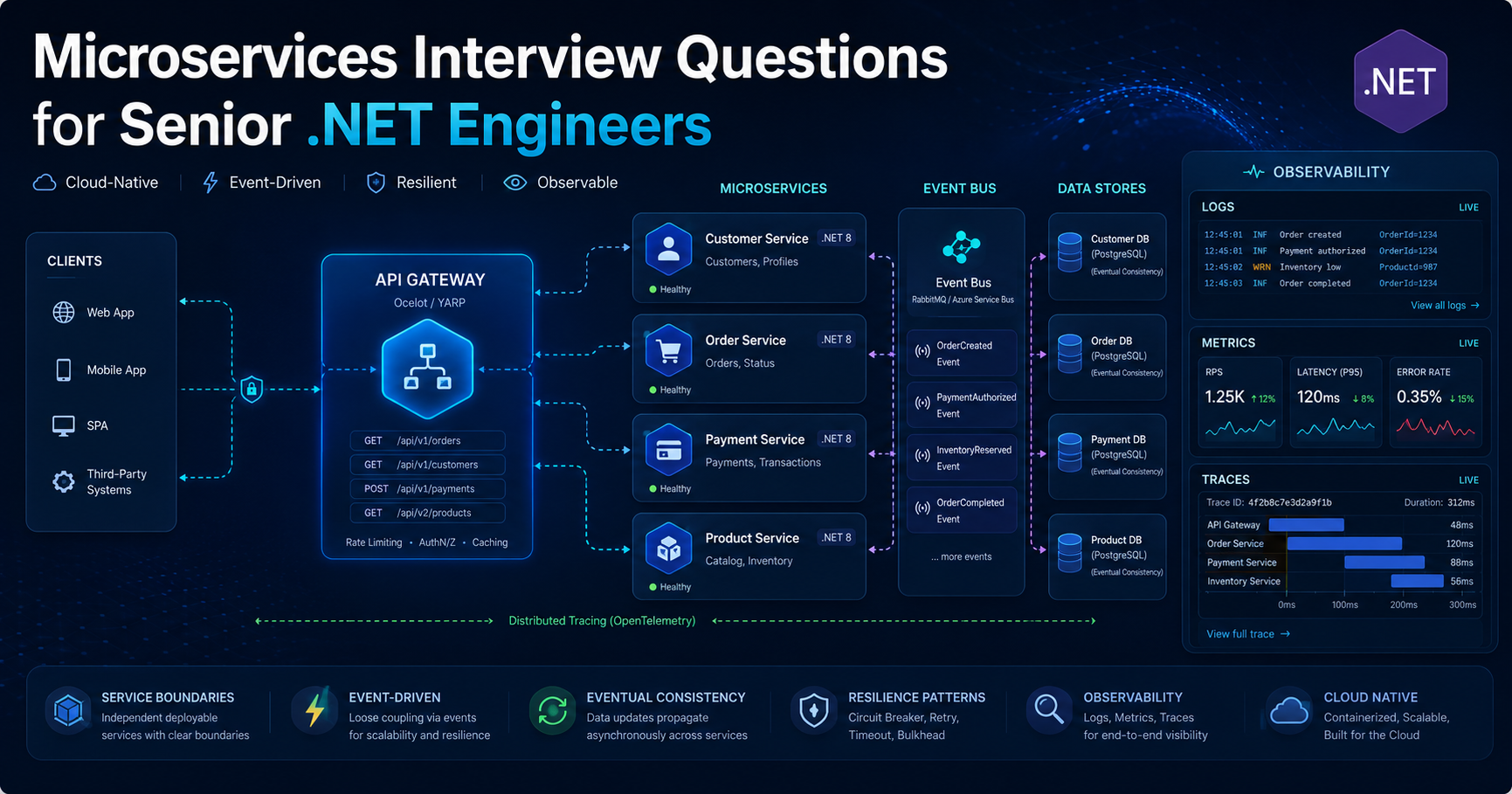
If you are preparing for senior backend, architect, or cloud-native .NET interviews, these are the areas you should be ready to explain with trade-offs, examples, and practical decision-making.
Who Should Read This
- Senior .NET engineers preparing for microservices interviews
- Technical leads and solution architects working with ASP.NET Core
- Developers moving from monoliths to distributed systems
- Engineers who want practical interview answers, not only theory
Key Takeaways
- Good service boundaries come from business capabilities and bounded contexts, not technical layers.
- An API gateway should handle edge concerns, not become a business-logic monolith.
- Distributed transactions across microservices are usually handled with sagas and compensating actions, not classic ACID across services.
- Eventual consistency is a design choice that must be understood and explained clearly in interviews.
- Observability in .NET microservices means logs, metrics, and distributed traces working together.
- API versioning should protect clients while allowing services to evolve independently.
Table of Contents
- Why This Topic Matters
- Microservices Interview Questions .NET Teams Should Know
- How do you decide service boundaries?
- What are signs that a service boundary is wrong?
- What is the purpose of an API gateway?
- When would you choose YARP, Azure API Management, or both?
- How do you handle distributed transactions?
- Choreography vs orchestration
- What does eventual consistency really mean?
- Why is idempotency important?
- What does good observability look like?
- How do you implement observability in .NET 10?
- How should you approach API versioning?
- Common microservices mistakes
- Upgrade Advice
- FAQ
- Final Thoughts
Why This Topic Matters
Microservices are attractive because they promise independent deployment, better scalability, and cleaner ownership. But in real systems, they also introduce harder problems: network latency, distributed failures, eventual consistency, contract versioning, and operational complexity.
That is why senior interview questions on microservices go deeper than “What is a microservice?” A strong answer shows that you understand not only the pattern, but also when it helps, when it hurts, and how to make it supportable in production.
Microservices Interview Questions .NET Teams Should Know
When I prepare for senior interviews, I focus on microservices interview questions .NET teams face in real projects, not only on theoretical definitions. The best answers usually combine architecture thinking, operational experience, and practical trade-offs.
1) How do you decide service boundaries?
Interview answer: I start with business capabilities and bounded contexts, not technical layers.
A senior engineer should explain that microservice boundaries should reflect domain ownership, data ownership, change cadence, and deployment independence. I do not split services just because the codebase has folders like Customer, Order, or Notification. I ask whether a capability can evolve independently without forcing other services to release at the same time.
Strong answer example:
“I define service boundaries around business capabilities and data ownership. If two components always change together, require strong consistency, and create excessive synchronous calls between them, that is usually a sign that the boundary may be wrong.”
2) What are signs that a service boundary is wrong?
Wrong boundaries usually show up in production before they show up in diagrams.
- Too many synchronous service-to-service calls for one user request
- Shared database tables across services
- Frequent joint deployments
- Repeated data consistency issues
- Teams blocked on each other for small changes
Senior-level answer:
“If my so-called microservices still need coordinated releases, shared schema changes, or long synchronous call chains for basic workflows, I treat that as a distributed monolith warning.”
3) What is the purpose of an API gateway in microservices?
An API gateway gives clients a simpler entry point into a distributed backend. It can centralize authentication, routing, rate limiting, SSL termination, request aggregation, and other edge concerns.
But a senior engineer should also say this clearly: the gateway should not become the place where core business workflows live.
Interview answer:
“I use the API gateway to simplify the client experience and handle cross-cutting concerns consistently. I do not push domain workflows into the gateway because that turns it into another monolith.”
4) When would you choose YARP, Azure API Management, or both?
For .NET teams, this is a very practical question.
YARP is a .NET-native reverse proxy option and works well when you want a highly customizable gateway built directly into an ASP.NET Core application.
Azure API Management is stronger when you need API governance, policies, analytics, developer onboarding, subscriptions, and external API exposure.
Interview answer:
“If I want a lightweight and customizable .NET gateway, I look at YARP. If I need external consumer management, policy-heavy control, and enterprise API governance, Azure API Management is a better fit. In some architectures, both are valid.”
5) How do you handle distributed transactions across microservices?
A senior .NET engineer should not answer this with “I use one transaction across all services.” That works in a monolith or tightly coupled system, but it is usually the wrong mental model for microservices.
In a proper microservices architecture, each service owns its own database transaction locally. Cross-service business workflows are usually coordinated with sagas, integration events, and compensating actions.
Interview answer:
“I keep each service transaction atomic within its own boundary. For workflows that span multiple services, I prefer saga-based coordination with compensating actions rather than trying to force traditional distributed ACID transactions across independent data stores.”
6) Choreography vs orchestration: which one do you prefer?
Both are valid saga styles, but the right choice depends on workflow complexity.
Choreography works well when services react to domain or integration events with minimal central coordination.
Orchestration works better when the business flow is complex, requires clear recovery logic, or needs stronger visibility for support and audit.
Interview answer:
“For simpler event-driven flows, choreography can work well. For multi-step business processes like order, payment, inventory, and shipping with compensation paths, I usually prefer orchestration because the workflow is easier to reason about, test, and support.”
7) What does eventual consistency really mean?
Eventual consistency means different services may not show the same state at the exact same moment, but they converge after asynchronous processing completes.
This is one of the most important ideas to explain well in a senior interview. It shows that you understand that distributed systems trade immediate consistency for autonomy, resilience, and scalability.
Interview answer:
“I treat eventual consistency as a deliberate architectural trade-off. I use it where immediate cross-service consistency is not essential, and I design workflows, read models, and user expectations around short-lived staleness.”
8) Why is idempotency important in microservices?
Because retries happen. Messages can be delivered more than once. HTTP calls can time out even after downstream processing succeeded. Event consumers can be re-run.
If a retry creates duplicate payments, duplicate orders, or duplicate shipments, the design is not production-ready.
Interview answer:
“I design commands, handlers, and consumers so the same request can be safely retried. Idempotency is essential for reliable distributed systems because failure and retry are normal behavior, not edge cases.”
9) What does good observability look like in a .NET microservices system?
Good observability means I can trace one user operation across services and answer these questions quickly:
- What failed?
- Where did it fail?
- How many requests are affected?
- Which dependency is the bottleneck?
That requires more than plain logging. It requires correlated logs, metrics, and distributed traces.
Interview answer:
“In a microservices environment, logging alone is not enough. I want end-to-end tracing, meaningful metrics, structured logs, correlation IDs, dependency visibility, and dashboards that help support teams isolate failures quickly.”
10) How do you implement observability in .NET 10?
In modern .NET, observability typically combines:
ILoggerfor structured loggingMeterfor metricsActivitySourcefor distributed tracing- OpenTelemetry exporters for Azure Monitor or other APM backends
Here is a simplified example using OpenTelemetry and API versioning in an ASP.NET Core API:
using Asp.Versioning;
using OpenTelemetry.Metrics;
using OpenTelemetry.Resources;
using OpenTelemetry.Trace;

var builder = WebApplication.CreateBuilder(args);

builder.Services.AddOpenTelemetry()
    .ConfigureResource(resource => resource.AddService("orders-api"))
    .WithTracing(tracing => tracing
        .AddAspNetCoreInstrumentation()
        .AddHttpClientInstrumentation()
        .AddSource("Orders")
        .AddOtlpExporter())
    .WithMetrics(metrics => metrics
        .AddAspNetCoreInstrumentation()
        .AddHttpClientInstrumentation()
        .AddRuntimeInstrumentation()
        .AddOtlpExporter());

builder.Services.AddApiVersioning(options =>
{
    options.DefaultApiVersion = new ApiVersion(1, 0);
    options.AssumeDefaultVersionWhenUnspecified = true;
    options.ReportApiVersions = true;
    options.ApiVersionReader = ApiVersionReader.Combine(
        new UrlSegmentApiVersionReader(),
        new HeaderApiVersionReader("x-api-version"));
})
.AddApiExplorer();

var app = builder.Build();

var versionSet = app.NewApiVersionSet()
    .HasApiVersion(new ApiVersion(1, 0))
    .HasApiVersion(new ApiVersion(2, 0))
    .ReportApiVersions()
    .Build();

var orders = app.MapGroup("/api/v{version:apiVersion}/orders")
    .WithApiVersionSet(versionSet);

orders.MapGet("/{id}", (int id) =>
    Results.Ok(new { id, version = "v1" }))
    .MapToApiVersion(1, 0);

orders.MapGet("/{id}", (int id) =>
    Results.Ok(new { id, version = "v2", includeTimeline = true }))
    .MapToApiVersion(2, 0);

app.Run();
11) How should you approach API versioning in microservices?
API versioning is about protecting consumers while still allowing services to evolve. A senior answer should focus on backward compatibility first, then use explicit versioning only when needed for breaking changes.
Interview answer:
“I prefer additive changes wherever possible. If I need a breaking change, I version the API explicitly, keep old consumers working during migration, and make the deprecation plan clear. I care more about consistency and client safety than about arguing whether versioning belongs in the URL or headers.”
12) What mistakes do senior engineers watch for in microservices?
- Splitting by technical layers instead of business capabilities
- Too many synchronous dependencies
- Using shared databases across services
- Forgetting idempotency
- Putting too much logic into the API gateway
- Ignoring observability until production issues appear
- Assuming strong consistency everywhere
- Versioning too late after clients are already coupled
To go deeper into production-ready distributed systems, also read Observability in .NET: Logging, Tracing, Metrics, and Application Insights and Resilient .NET APIs: Retry, Circuit Breaker, Timeout, and Idempotency .
Microsoft also provides useful guidance on designing microservices in .NET in its official .NET microservices architecture documentation .
Upgrade Advice
If you are still preparing from older .NET material, update your interview examples to modern .NET thinking. Interviewers increasingly expect answers that mention OpenTelemetry, distributed tracing, idempotent message handling, pragmatic API versioning, and .NET-native gateway options like YARP where appropriate.
I would also recommend practicing at least one realistic example, such as Order, Payment, Inventory, and Shipping, because senior interviews often shift from theory into scenario-based design discussions.
FAQ
Are microservices always better than monoliths?
No. Microservices add operational and data consistency complexity. They are useful when independent deployment, team ownership, and scale justify that complexity.
What is the most important microservices topic for senior interviews?
Usually service boundaries and distributed data consistency. Those two topics reveal whether someone understands real microservices architecture or only surface-level terminology.
Should microservices always use asynchronous communication?
No. Synchronous APIs are still useful, especially for queries or immediate request-response needs. But too many synchronous dependencies can make the system brittle, so asynchronous messaging is often preferred for cross-service workflows.
Is eventual consistency acceptable in enterprise systems?
Yes, in many scenarios. The key is knowing where it is acceptable and designing the workflow, compensation logic, and user experience accordingly.
What should I mention about observability in a .NET interview?
Mention structured logging, metrics, distributed tracing, correlation IDs, OpenTelemetry, and an operational mindset for production support.
Final Thoughts
For senior .NET interviews, strong microservices answers are not about memorizing buzzwords. They are about explaining trade-offs clearly: where boundaries belong, when a gateway helps, why sagas replace cross-service ACID thinking, how eventual consistency affects design, and why observability must be built in from the beginning.
These Microservices Interview Questions for Senior .NET Engineers help you prepare for real-world architecture discussions, not just theory. If you can explain these topics with confidence and practical examples, you will sound like someone who has actually built and supported distributed systems.
Recommended AI Tools & Resources
If you found this article useful, here are some AI tools and resources from AINexArch that can help you work faster and smarter:
- Best AI Writing Tools 2026 — top tools for writing, content, and productivity
- ChatGPT vs Claude 2026 — which AI is better for developers?
- Best Free AI Tools 2026 — powerful AI tools that cost nothing
- Best AI Tools for Content Creators 2026 — complete guide
If you create technical videos, tutorials, or podcast content alongside your development work, ElevenLabs is the best AI voice generator available in 2026. Turn your written content into professional audio in seconds.
👉 Try ElevenLabs Free — Best AI Voice Generator 2026
Disclosure: This article contains affiliate links. If you sign up through my link, I may earn a commission at no extra cost to you.