
Originally published: March 2026. Updated: May 2026.
AI vs Machine Learning vs Deep Learning is one of the most common questions beginners ask when they start learning artificial intelligence. These three terms are closely related, but they are not the same.
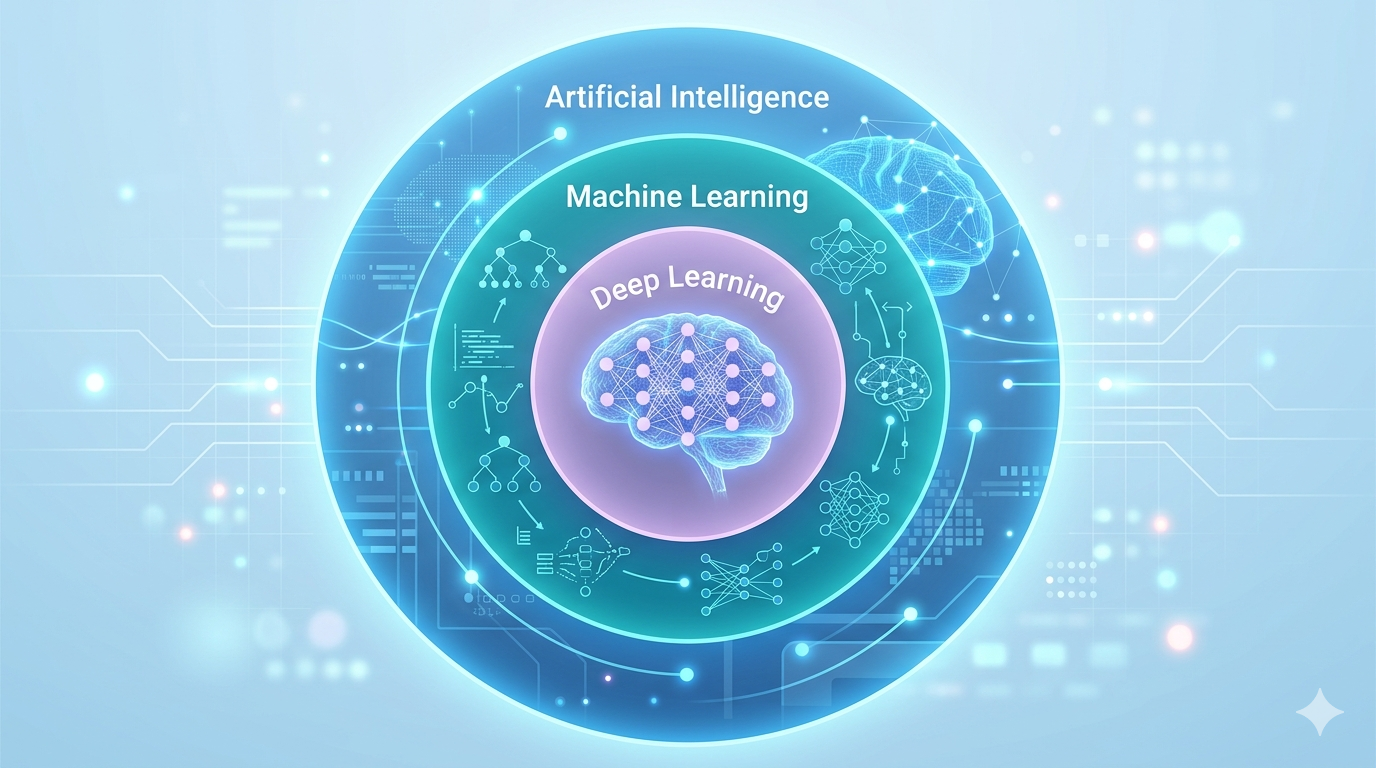
In simple words, Artificial Intelligence is the broad idea of making machines act intelligently. Machine Learning is a subset of AI where systems learn from data. Deep Learning is a subset of machine learning that uses neural networks to solve more complex problems.
For developers and technology professionals, understanding the difference between AI, machine learning, and deep learning is an important foundation before learning generative AI, RAG, AI agents, or AI application architecture.
Simple way to remember:
AI is the big field. Machine Learning is inside AI. Deep Learning is inside Machine Learning.
Who Should Read This?
- Beginners who are starting their AI learning journey
- Developers who want to understand AI fundamentals clearly
- Students preparing for AI, machine learning, or data science interviews
- Professionals exploring generative AI, RAG, and AI agents
Key Takeaways
- AI is the broad field of building intelligent systems.
- Machine Learning is a subset of AI that learns patterns from data.
- Deep Learning is a subset of Machine Learning that uses neural networks.
- Generative AI and large language models are mostly powered by deep learning.
- You do not need to learn everything at once. Start with AI basics, then move to ML and deep learning concepts.
Table of Contents
- What Is Artificial Intelligence?
- What Is Machine Learning?
- What Is Deep Learning?
- AI vs Machine Learning vs Deep Learning: Simple Comparison
- Real-World Examples
- Where Does Generative AI Fit?
- Which One Should You Learn First?
- FAQ
What Is Artificial Intelligence?
Artificial Intelligence, or AI, is the broad field of creating systems that can perform tasks that normally require human intelligence. These tasks may include understanding language, recognizing images, making decisions, solving problems, or generating content.
AI does not always mean a system is learning from data. Some AI systems may use predefined rules, logic, search algorithms, or decision trees. Other AI systems may use machine learning models that improve based on data.
Examples of AI include:
- Chatbots
- Voice assistants
- Recommendation systems
- Fraud detection systems
- Self-driving car decision systems
- AI-powered document processing tools
You can think of AI as the umbrella term. Machine learning and deep learning are important parts of AI, but AI is broader than both.
Related reading: What Is Artificial Intelligence?
What Is Machine Learning?
Machine Learning, or ML, is a subset of artificial intelligence where systems learn from data instead of being explicitly programmed for every rule.
In traditional programming, developers write rules manually. In machine learning, developers provide data, and the model learns patterns from that data.
For example, instead of writing hundreds of rules to detect spam emails, a machine learning model can learn from examples of spam and non-spam emails. Over time, it identifies patterns and makes predictions on new emails.
Common examples of machine learning include:
- Email spam detection
- Product recommendations
- Customer churn prediction
- Credit risk scoring
- Fraud detection
- Sales forecasting
Machine learning is very useful when the problem depends on patterns in data and those patterns are difficult to write manually as simple rules.
What Is Deep Learning?
Deep Learning is a subset of machine learning that uses artificial neural networks with multiple layers. These neural networks are inspired by the way the human brain processes information, but they are mathematical models, not human brains.
Deep learning is especially powerful for complex data such as images, audio, video, and natural language. It can discover patterns that are difficult for traditional machine learning models to capture.
Common examples of deep learning include:
- Image recognition
- Speech recognition
- Language translation
- Large language models
- Medical image analysis
- Generative AI tools
Deep learning usually requires more data, more computing power, and more training time compared to traditional machine learning.
AI vs Machine Learning vs Deep Learning: Simple Comparison
The easiest way to understand the relationship is this:
- AI is the broad goal: make machines intelligent.
- Machine Learning is one way to achieve AI by learning from data.
- Deep Learning is a more advanced type of machine learning using neural networks.
| Topic | Artificial Intelligence | Machine Learning | Deep Learning |
|---|---|---|---|
| Meaning | Broad field of intelligent systems | AI that learns from data | ML using deep neural networks |
| Scope | Broadest | Subset of AI | Subset of ML |
| Data Needed | Low to high | Medium to high | Very high |
| Complexity | Can be simple or complex | Moderate to advanced | Advanced |
| Examples | Chatbots, rules engines, voice assistants | Recommendations, fraud detection, spam filters | Image recognition, speech recognition, LLMs |
| Best For | Automation and decision support | Predictions and pattern discovery | Complex data like images, audio, and text |
Real-World Examples of AI, Machine Learning, and Deep Learning
Example 1: Customer Support Chatbot
A basic chatbot that follows predefined rules can be considered AI because it simulates intelligent conversation. If the chatbot learns from customer conversations and improves its answers, it uses machine learning. If it uses a large language model to understand and generate natural responses, it is using deep learning.
Example 2: Product Recommendations
An e-commerce website may recommend products based on browsing history, purchase behavior, or similar users. This is usually a machine learning use case because the system learns patterns from data and predicts what a customer may like.
Example 3: Image Recognition
A system that identifies objects in images, detects faces, or analyzes medical scans often uses deep learning. Deep neural networks are very strong at finding patterns in visual data.
Example 4: Fraud Detection
Fraud detection systems may use machine learning to find unusual transaction patterns. These systems can help banks, payment platforms, and businesses identify suspicious activity faster.
Where Does Generative AI Fit?
Generative AI is a type of AI that can create new content such as text, images, code, audio, or video. Many modern generative AI systems are powered by deep learning models.
Large language models, such as the models behind AI chat applications, are examples of deep learning systems. They are trained on large amounts of text data and can generate human-like responses.
So, generative AI fits inside the larger AI world and is strongly connected to deep learning.
Related reading: What AI Can and Cannot Do
Which One Should You Learn First?
If you are new to AI, do not start by trying to learn everything at once. Start with the big picture first.
- Start with AI basics: Understand what AI is, what it can do, and where it is used.
- Learn machine learning concepts: Understand data, training, models, predictions, and evaluation.
- Explore deep learning: Learn about neural networks, large language models, computer vision, and speech AI.
- Move to practical AI applications: Explore generative AI, RAG, AI agents, and cloud-based AI services.
For developers, the goal is not only to understand AI theory. The real value comes from knowing how to apply AI safely and practically in applications.
Related reading: What Is RAG in AI? and RAG Architecture Explained Simply
Common Beginner Confusion
Many beginners think AI, machine learning, and deep learning are three separate technologies. A better way to understand them is as layers.
AI is the largest layer. Machine learning is one part of AI. Deep learning is one part of machine learning. This is why all deep learning is machine learning, and all machine learning is AI, but not all AI is machine learning.
Important: AI can include rule-based systems, search algorithms, planning systems, machine learning models, deep learning models, and generative AI systems.
Final Thoughts
The difference between AI vs Machine Learning vs Deep Learning becomes simple when you understand the hierarchy. AI is the broad field. Machine learning is a subset of AI. Deep learning is a subset of machine learning.
If you are starting your AI learning journey, focus first on understanding the concepts clearly. Once the foundation is strong, it becomes much easier to learn generative AI, RAG, AI agents, and real-world AI application development.
To continue learning, visit the Learn page or explore practical tools on the AI Tools page.
FAQ: AI vs Machine Learning vs Deep Learning
Is AI the same as machine learning?
No. AI is the broader field of creating intelligent systems. Machine learning is a subset of AI where systems learn from data.
Is deep learning better than machine learning?
Deep learning is not always better. It is powerful for complex problems like image recognition, speech recognition, and natural language processing. Traditional machine learning may be better for smaller datasets or simpler prediction problems.
Is ChatGPT AI, machine learning, or deep learning?
ChatGPT is an AI system powered by machine learning and deep learning. It uses large language model technology to understand and generate text.
Should beginners learn AI or machine learning first?
Beginners should start with AI basics first. After understanding the big picture, they can move into machine learning concepts and then deep learning.
Where does generative AI fit?
Generative AI is part of the larger AI field. Most modern generative AI systems are powered by deep learning models.
Do I need to know math to learn AI?
Basic math helps, especially for machine learning and deep learning. However, beginners can first understand the concepts, use cases, and tools before going deep into the math.
Recommended AI Tools & Resources
If you found this article useful, here are some AI tools and resources from AINexArch that can help you work faster and smarter:
- Best AI Writing Tools 2026 — top tools for writing, content, and productivity
- ChatGPT vs Claude 2026 — which AI is better for developers?
- Best Free AI Tools 2026 — powerful AI tools that cost nothing
- Best AI Tools for Content Creators 2026 — complete guide
If you create technical videos, tutorials, or podcast content alongside your development work, ElevenLabs is the best AI voice generator available in 2026. Turn your written content into professional audio in seconds.
👉 Try ElevenLabs Free — Best AI Voice Generator 2026
Disclosure: This article contains affiliate links. If you sign up through my link, I may earn a commission at no extra cost to you.