
Artificial intelligence is everywhere today. It writes emails, recommends movies, helps diagnose diseases, and even generates code. With so much hype, it is easy to assume AI is either a magical solution to every problem or a dangerous force beyond control. The truth lies somewhere in between.
This article offers a clear and practical reality check on what AI can genuinely do today, and where its limits still matter.
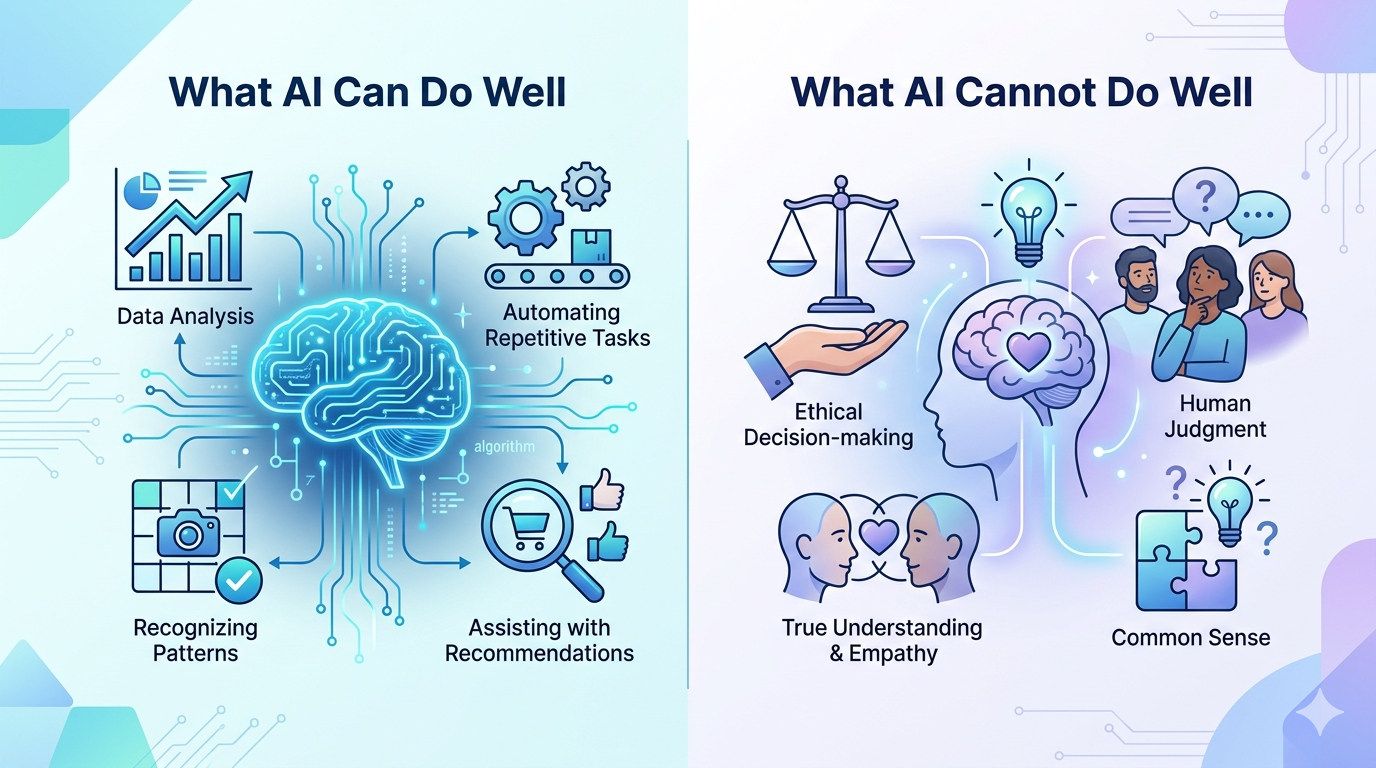
What AI Can Do Well
1. Process Massive Amounts of Data
AI excels at analyzing large datasets far beyond human capacity. It can:
-
Detect patterns in medical scans
-
Identify fraud in financial transactions
-
Analyze customer behavior across millions of interactions
Reality: AI is fast, consistent, and scalable when data is structured and abundant.
2. Automate Repetitive and Predictable Tasks
AI is highly effective at tasks that follow clear rules or patterns, such as:
-
Sorting emails and support tickets
-
Transcribing meetings
-
Scheduling, routing, and classification
Reality: AI boosts productivity by handling routine work, not by replacing strategic thinking.
3. Support Human Decision-Making
AI can provide recommendations by surfacing insights humans might miss, such as:
-
Suggesting next-best actions in sales
-
Flagging anomalies in system logs
-
Highlighting risks in legal or compliance reviews
Reality: AI supports decisions, but it does not own them.
4. Generate Content With Guidance
Modern AI can draft:
-
Articles and summaries
-
Code snippets
-
Marketing copy and documentation
Reality: AI generates drafts, not final truth. Human review is essential.
5. Learn Patterns From Historical Data
Machine learning models improve by learning from past examples. They can help with:
-
Predicting demand
-
Forecasting trends
-
Classifying images or text
Reality: AI learns correlations, not meaning or intent.
What AI Cannot Do Despite the Hype
1. Truly Understand Context Like Humans
AI does not possess:
-
Consciousness
-
Self-awareness
-
Genuine understanding
It predicts what comes next based on probability, not comprehension.
Reality: AI can sound confident while being completely wrong.
2. Make Ethical or Moral Judgments
AI has no values of its own. Any ethics it appears to follow come from:
-
Human-designed rules
-
Training data
-
Organizational constraints
Reality: Responsibility always lies with humans, not machines.
3. Replace Human Creativity
AI can remix, imitate, and combine ideas, but it cannot:
-
Experience curiosity
-
Feel inspiration
-
Create with intent or purpose
Reality: AI can augment creativity, but it does not originate it.
4. Perform Reliably Without Quality Data
AI is only as good as the data it is trained on.
-
Biased data leads to biased outputs
-
Incomplete data leads to misleading results
Reality: AI does not fix bad data. It amplifies it.
5. Adapt Perfectly to New or Unexpected Situations
Humans can reason through unfamiliar situations using intuition and judgment. AI struggles when:
-
The situation differs from its training data
-
Rules change suddenly
-
Context is ambiguous
Reality: AI lacks common sense.
The Biggest Misconception About AI
AI is not autonomous intelligence. It is applied mathematics at scale.
It does not:
-
Think independently
-
Set its own goals
-
Understand consequences
Every AI system reflects human choices, including what data was used, what objectives were set, and what constraints were imposed.
The Right Way to Think About AI
Instead of asking, “Can AI replace humans?”
Ask, “How can AI responsibly amplify human capability?”
The most successful AI implementations:
-
Keep humans in the loop
-
Focus on augmentation, not replacement
-
Combine machine efficiency with human judgment
Final Takeaway
AI is powerful, but it is not magical.
Impressive, but not infallible.
Transformative, but not autonomous.
Understanding both its strengths and its limits is the key to using AI wisely, ethically, and effectively.
AI is a tool. Humans remain accountable.
Recommended AI Tools & Resources
If you found this article useful, here are some AI tools and resources from AINexArch that can help you work faster and smarter:
- Best AI Writing Tools 2026 — top tools for writing, content, and productivity
- ChatGPT vs Claude 2026 — which AI is better for developers?
- Best Free AI Tools 2026 — powerful AI tools that cost nothing
- Best AI Tools for Content Creators 2026 — complete guide
If you create technical videos, tutorials, or podcast content alongside your development work, ElevenLabs is the best AI voice generator available in 2026. Turn your written content into professional audio in seconds.
👉 Try ElevenLabs Free — Best AI Voice Generator 2026
Disclosure: This article contains affiliate links. If you sign up through my link, I may earn a commission at no extra cost to you.